
Mitchell County VINELink Coverage
Kansas Victim Information and Notification Everyday, commonly called Kansas VINE, is the state service reached through VINELink. The Kansas Attorney General describes it as a public custody-information and notification system for county jails. Mitchell County Jail links to Kansas VINE throughout its official navigation even though the jail publishes no current roster. That makes VINE the county-endorsed online channel for a person-specific jail check.
The coverage boundary matters. Kansas VINE includes participating county-jail information and can report changes supplied by those agencies. It expressly excludes people held in Kansas Department of Corrections prisons. KASPER, the KDOC offender search, is the correct public system after a person enters state corrections. VINELink also is not the federal Bureau of Prisons locator, the ICE detainee locator, a court docket, or a historical list of everyone released from Mitchell County.
Coverage rule: use Kansas VINE for Mitchell County Jail custody and alerts. Use KASPER for KDOC incarceration, parole, postrelease supervision, or discharge. A transfer can require both systems in sequence.
Search One Mitchell County Inmate on VINELink
A useful search starts with the correct state and person. VINELink interfaces can change, so button names may differ from the description below. The core process remains a Kansas custody search followed by careful identity and facility comparison.
- Open Kansas VINE. Follow the Mitchell County Jail's VINE link or open VINELink and select Kansas. Do not assume a browser result has already placed the search in the right state.
- Choose the custody or offender search. Enter the person's legal name or another identifier the current interface accepts. Try documented spelling variants if the first search produces no match.
- Review every candidate. A common name can return several people. Compare all displayed identifying details and the participating facility instead of choosing the first result.
- Open the matching record. Confirm that Mitchell County Jail, or the expected receiving county jail, is named. Read the custody wording and its status date together.
- Separate release from transfer. A released result marks a county-jail custody change, but it may not explain whether the person entered the community, another county, treatment, or a different custodian.
- Follow up on no-result or ambiguity. Retry name variations, use VINE telephone support, or call Mitchell County Jail. Do not turn silence into a claim that the person was released.
The broader Mitchell County released-inmate guide explains how to pair the status with a jail release record, court order, or receiving-agency record. That affirmative event evidence is more reliable than a missing search result.
Mitchell County VINELink Release Fields
VINELink is designed for current custody information and notifications, not a certified release document. The exact public fields can change, and not every record displays every item. Read each field only for the narrow fact it supports.
| Field or result | What it supports |
|---|---|
| Name and available identifiers | Helps distinguish the intended person from another person with a similar name. It must be compared with all available details. |
| Participating facility | Identifies the county jail reporting the record. Mitchell County Jail coverage does not imply KDOC, federal, or immigration coverage. |
| Custody status | Shows the status supplied by the participating jail, such as custody or a reported release-related change. Wording should not be expanded beyond what appears. |
| Status date | Places the reported status in time. It is not automatically the same as a court date, community-arrival time, or sentence-discharge date. |
| Notification option | Allows registration for offered custody-change alerts. Availability and delivery choices are controlled by the live service. |
Unlike KASPER, Kansas VINE is not the source for a KDOC “Anticipated release date,” conviction history, parole office, or state-corrections movement record. Likewise, a VINELink status is not the Mitchell jail's complete booking-and-release sheet. Request that record when the exact release time, type, destination, or authorizing order matters.
Why Mitchell County Uses VINELink Instead of a Roster
Mitchell County has an unusual local information pattern. The jail's official information page says it does not publish a current-inmate list, yet the jail prominently provides its Kansas VINE link. There is therefore no official Mitchell roster to browse and no name-disappearance signal to interpret. A person-specific VINE check is the available online custody channel, while direct telephone confirmation and a records request remain necessary fallbacks.
This distinction also prevents a common error. VINELink is not a recent-release feed. It does not provide an official Mitchell County 24-hour list, 72-hour archive, update cadence, historical release log, or county booking-photo gallery. VINEMobile offers access to notification functions; it does not convert the service into a retrospective list of everyone who left the jail during a chosen period.
For a period-wide answer, ask the Mitchell County Jail for the public portions of release or discharge transactions during an exact start and end time. For one person, VINE, the jail, and the controlling court record form a stronger chain. If the person entered KDOC custody, add KASPER rather than forcing a state-prison question into VINELink.
Open the Official VINELink Release Check
The official VINELink entry point is the appropriate place to select Kansas, find the correct person, and begin a notification registration.
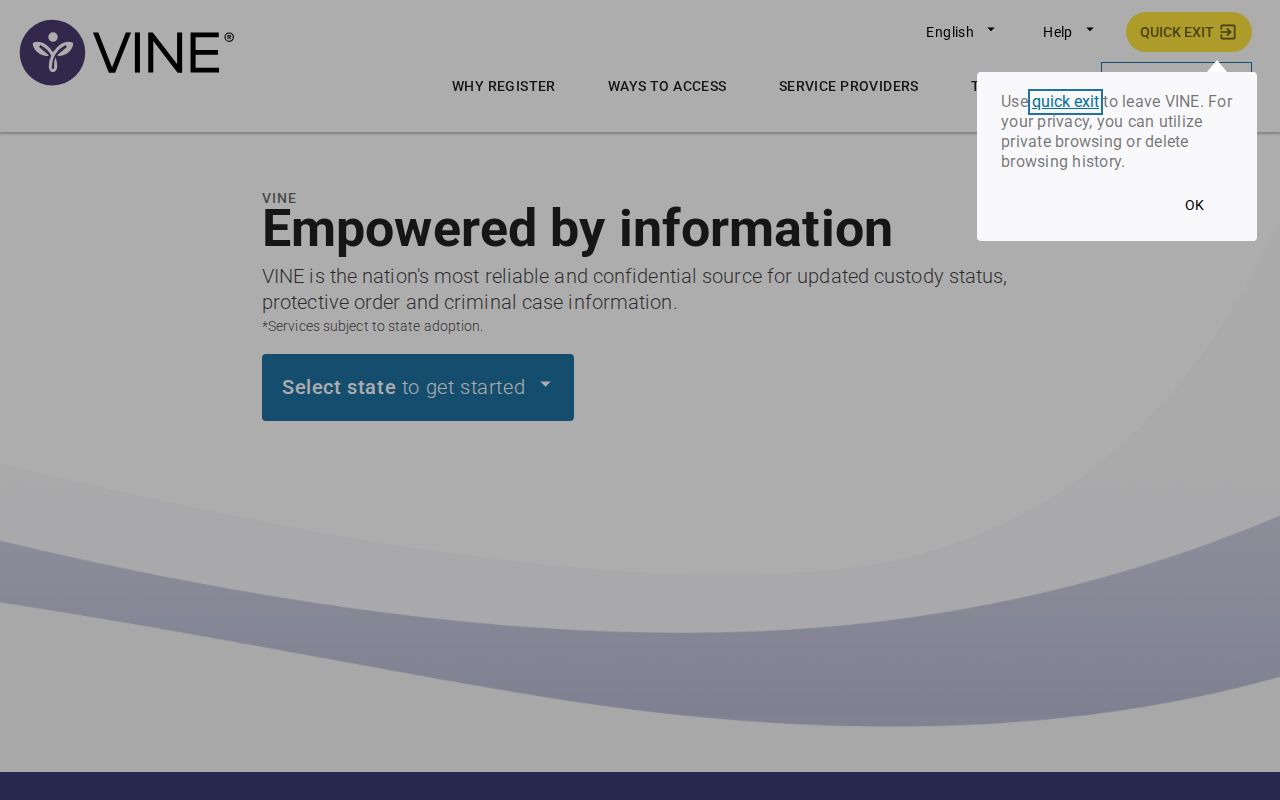
The screen is an entry point, not proof of any person's status. Select Kansas, match the person and reporting facility, and retain the status date or registration confirmation needed for later follow-up. Never fabricate a test name or assume a result concerns Mitchell County merely because the search began on this page.
Register for Mitchell County Release Alerts
Registration turns a one-time search into notice of later custody changes offered by Kansas VINE. The service is free, and the Kansas Attorney General describes live-operator and multilingual assistance. No one should ask for payment merely to create a VINE registration.
- Open the correct person's record. Recheck the identifying information and facility before choosing the registration or notification control.
- Select an available delivery method. Choose telephone, email, or another channel actually offered by the current interface. Do not assume every method appears for every registration.
- Enter the destination accurately. A mistyped number or address can prevent notice. Use contact information that will remain available.
- Complete the security step. For telephone alerts, create or enter the PIN requested by the live system and keep it available. The PIN may be needed to confirm receipt, stop calls, or replay information. No fixed PIN length should be assumed.
- Confirm the registration. Follow any telephone prompt, email link, or code shown by VINELink. Save the confirmation so the registration can be checked later.
- Maintain the registration. Update contact information if it changes and follow the service's instructions for managing alerts.
- Verify the event. Treat an alert as a prompt to contact the jail or check the next source, especially when safety, pickup, a court appearance, or another hold makes the distinction important.
Notifications depend on the participating agency's data and the delivery channel. The research does not support a promise that every alert is instantaneous. Telephone support is available through Kansas VINE at 1-866-574-7463 when the online search or registration does not resolve the issue.
Confirm a Mitchell County VINELink Release
A reported release should be read as a change in the county jail's custody, not a blanket statement that the person has returned home. Mitchell County may release someone on bond, after completion of a local sentence, or under a court order. The jail may also send someone to treatment, transfer a “housing only” detainee to the county responsible for the case, or deliver a sentenced person to KDOC. Transport timing can be withheld for security.
If VINE says released but the person has not arrived in the community, call Mitchell County Jail and ask whether the event was community release or transfer. Then identify the receiving custodian. A county release entry and a receiving-agency intake can be complementary records of the same movement. When KDOC received the person, KASPER becomes the continuing public locator, but that movement is not a KDOC discharge.
Operational records can help resolve that distinction. Mitchell's jail rules say remaining account money is returned by check or debit card upon release, while money is forwarded to KDOC when a person transfers to prison. Mail received after either release or transfer is returned to the sender within 48 hours, and property left after release is kept for 30 days under the stated rules. These details explain local processing, but none independently proves where a particular person went. Ask for the public booking and release or discharge record, including the release type or destination, actual date and time, and public authorizing order. If the transaction was a transfer, the receiving agency's intake closes the evidentiary gap.
The court record answers a related but narrower question. A bond, dismissal, sentence, or termination order may authorize a custody change, yet the jail still must process it and account for other holds. If one Mitchell case permits release while another county has a warrant, the person can leave Mitchell custody through transfer. VINELink reports the participating jail's change, not clearance of every case in every jurisdiction.
Do not infer status from silence. A no-result may reflect spelling, a recent update, a transfer, a different agency, or limited historical coverage. VINELink also does not cover BOP custody. Confirm with the jail, court, KASPER, BOP, ICE, or another responsible custodian as the facts require.
A court order can explain why release was authorized, but an order and physical departure are different events. Conversely, a jail departure does not settle every charge or sentence. The strongest conclusion joins the reported VINE change to the jail transaction and, when relevant, the court or receiving-agency record.