
Mitchell Parole and Probation
Parole, postrelease supervision, and probation can all place a person under rules in the community, but they come from different legal paths. Kansas parole mainly concerns indeterminate sentences, which do not state one fixed prison term in the same way as modern guideline sentences. The Kansas Prisoner Review Board decides suitability in those cases. For most determinate guideline sentences, release follows sentence computation and is followed by postrelease supervision. Probation is a court sentence or court-ordered alternative that may begin without a state-prison term or after a local jail stay.
The difference controls where to verify the record. The KASPER offender search can show parole, conditional release, postrelease supervision, discharge, and a listed parole office for people in the Kansas corrections population. Mitchell County district-court records are the better source for local probation. A county-jail release does not by itself establish either status.
| Status | Who controls it | Best verification |
|---|---|---|
| Parole | Kansas Prisoner Review Board and KDOC | KASPER status, movement, office, and Board record |
| Postrelease supervision | KDOC after a determinate prison term | KASPER and the listed parole office |
| Probation | Sentencing district or municipal court | Court docket, order, and supervising court office |
| Discharge | The agency or court with authority | Discharge certificate or termination order |
- Parole
- Supervised release from an indeterminate prison sentence after a Board decision.
- Probation
- A court-ordered sentence served under conditions in the community.
- Postrelease supervision
- Supervision that follows the prison part of a determinate Kansas sentence.
- Discharge
- The end of the corrections or court supervision obligation.
Verify Mitchell Post-Release Supervision
Start with the last known sentence, not a guess based on where the person was arrested. A Mitchell County conviction does not prove that the person now lives in the county or reports to the Salina office. KASPER may list the actual office. For probation, the controlling court case matters because a jail custody result does not show all later court supervision events.
- Identify whether the person had a KDOC prison sentence or a district-court probation sentence.
- For a KDOC case, search KASPER by KDOC number when known, or compare name, birth date, conviction county, case, and photograph.
- Read current status, status date, movement history, supervision level, and the parole office on the individual record.
- For probation, search the Kansas District Court Public Access Portal for sentencing, violation, revocation, and termination entries.
- Contact the office or court named in the current record when the public entry is unclear or an official document is needed.
A “released” custody result proves less than a supervision record. It may show that one jail hold ended, while probation, parole, postrelease, another hold, or transfer remains. KASPER’s “Anticipated release date” is also an estimate, not an actual movement. Current status and later movement entries control the immediate reading.
For a durable answer, request the supervision certificate, discharge certificate, Prisoner Review Board decision, or court termination order. The official record should match the precise question. Prison departure and final sentence discharge are separate milestones.
Kansas VINE does not fill this supervision gap. It covers participating county jails and excludes KDOC prisons. A Mitchell jail custody-change alert can help establish that one local hold ended, but it cannot show that a person began parole, reports to a particular office, or completed probation. Use KASPER for the state-corrections status and the court file for probation. When movement crosses systems, preserve each agency’s record instead of forcing one result to answer the whole timeline.
Mitchell Parole Office Coverage
The KDOC parole-office directory assigns Mitchell County to the Salina Parole Office in the Northern Region. That is the local starting point for a state-supervision question. Still, the office printed on a person’s current KASPER record takes priority. Supervision can follow the person’s location, and conviction county does not always match residence or reporting office.
Salina Parole Office
919 E. Prescott, Suite 300
Salina, KS 67401
785-827-2584
No office hours were established in the Mitchell research, so confirm access before visiting. The Salina office verifies KDOC supervision, not local court probation. Questions about a Mitchell probation order belong with the court and the supervising service named in that case.
The Prisoner Review Board public-comment calendar is forward-looking. It lists upcoming sessions and can include commitment name, KDOC number, conviction county, case, and offense. It is not a public person-by-person decision-results database, and a hearing listing does not prove release.
Eligibility depends on the offense date, sentence type, offense, minimum term, and statutory exclusions under K.S.A. 22-3717. The Board cannot release a person before legal eligibility. Its published process identifies parole, continue, and pass outcomes. “Continue” postpones a decision for more review or information. “Pass” denies parole for a stated period. Even a parole grant does not prove that the person physically departed, because release planning, another sentence, a detainer, or processing may intervene.
Later KASPER status and movement data provide the practical follow-up. When the public record does not resolve the result, contact the Board or request the named decision. The public calendar and aggregate reporting should never be described as a searchable database of final decisions.
Mitchell Absconder Status Checks
KDOC provides a separate parole absconder search. An absconder is a supervised person whose whereabouts are deliberately unknown to the supervising authority under the applicable standard. The public page itself warns against making an arrest solely from its information. A listing should prompt confirmation with law enforcement, the court, or the named supervision office.
An absconder result and a warrant are related but not identical claims. The web entry does not independently prove that a currently executable warrant exists. A probation violation may also be filed in the district-court case without creating a KDOC parole-absconder entry. Search the system tied to the supervision type, then request the current order when legal process depends on the answer.
Conditions can include reporting, approved residence, treatment, travel limits, and other case-specific duties, but no single public list proves one person’s exact terms. A violation may lead to a sanction, changed conditions, revocation, or custody after due process. It does not erase the need to read the current order and status.
The official manifest image shows the KASPER parole absconder lookup.
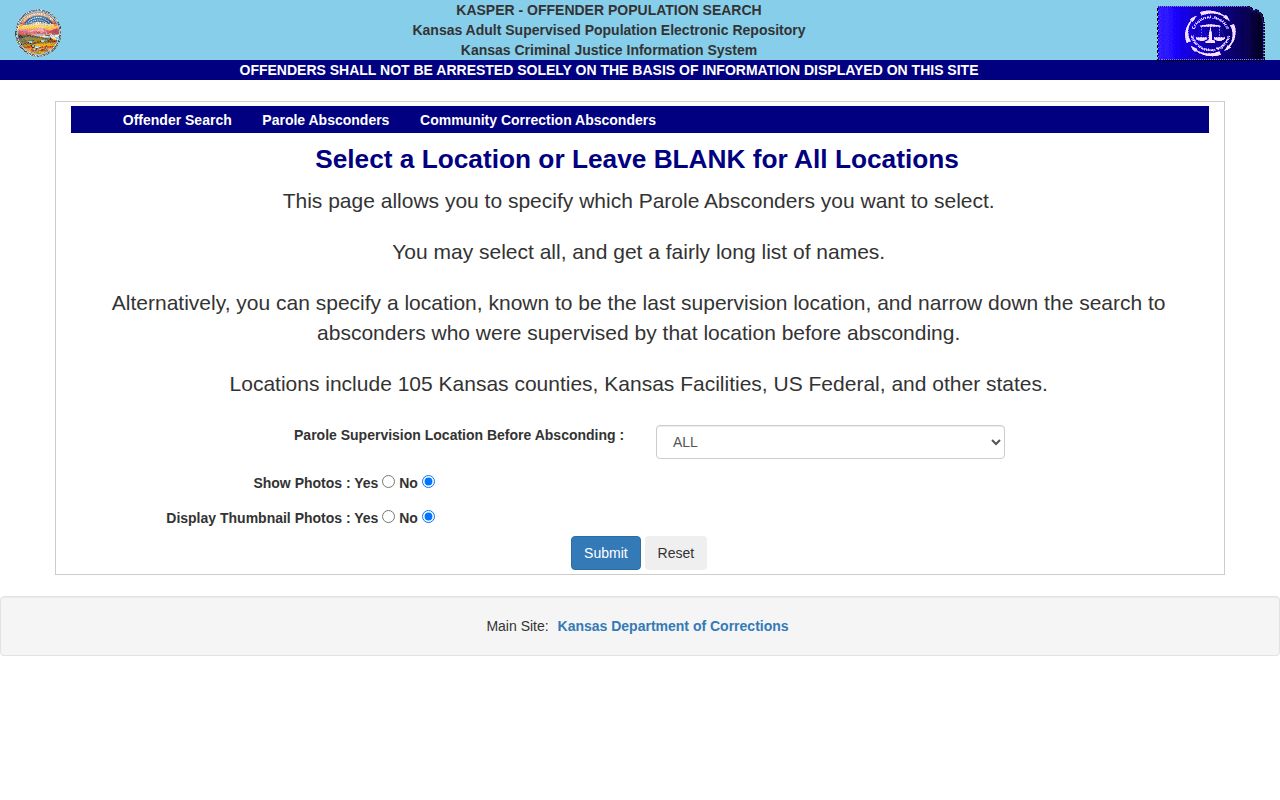
The lookup is a lead for verification, not authority to act on a person without current agency confirmation.
Mitchell Supervision Discharge Records
Supervision ends through an official act, not merely because time passed or a person stopped appearing in one search. For KDOC, a discharged status and date are stronger public markers than parole or postrelease status. A discharge certificate supplies the durable record. For local probation, K.S.A. 21-6608 contemplates a court order upon termination. The docket may show expiration, early termination, violation, or revocation before the signed order is available online.
Use the KDOC KORA request route for a narrow request such as a discharge certificate, supervision certificate, actual release movement, or Board decision. Use the district clerk for the court order that ends Mitchell County probation. Kansas Open Records Act fees can reflect actual furnishing, review, and redaction costs, so ask for an electronic copy and an estimate instead of assuming a flat charge.
The broader Mitchell County released inmate search and record path explains how a jail release, court order, and corrections record fit together. Those records should not be collapsed into one date. A person can leave jail, enter probation, and complete probation much later.
Property After Mitchell Release
Mitchell County Jail property rules add a useful clue when a custody event could be either community release or transfer. During custody, a person may sign a Release of Property form that names the recipient and the items. The recipient must show identification. That process does not itself prove release because property can be authorized while the person remains confined.
After release, unclaimed property is retained for 30 days and then destroyed under the official inmate rules. A remaining account balance is returned by check or debit card on release. If the person transfers to KDOC prison custody, the balance is forwarded to KDOC instead. That money-handling difference can help frame the question for jail staff, but the release or transfer transaction remains the proof.
Property and money records also answer a different question from supervision. They can show how the jail processed departure. KASPER, the parole office, or a court order establishes what authority continued after that departure.
Note: A signed property release can occur during confinement, so it must never be treated as proof that Mitchell County custody ended.
Public Record Search
Sponsored Results